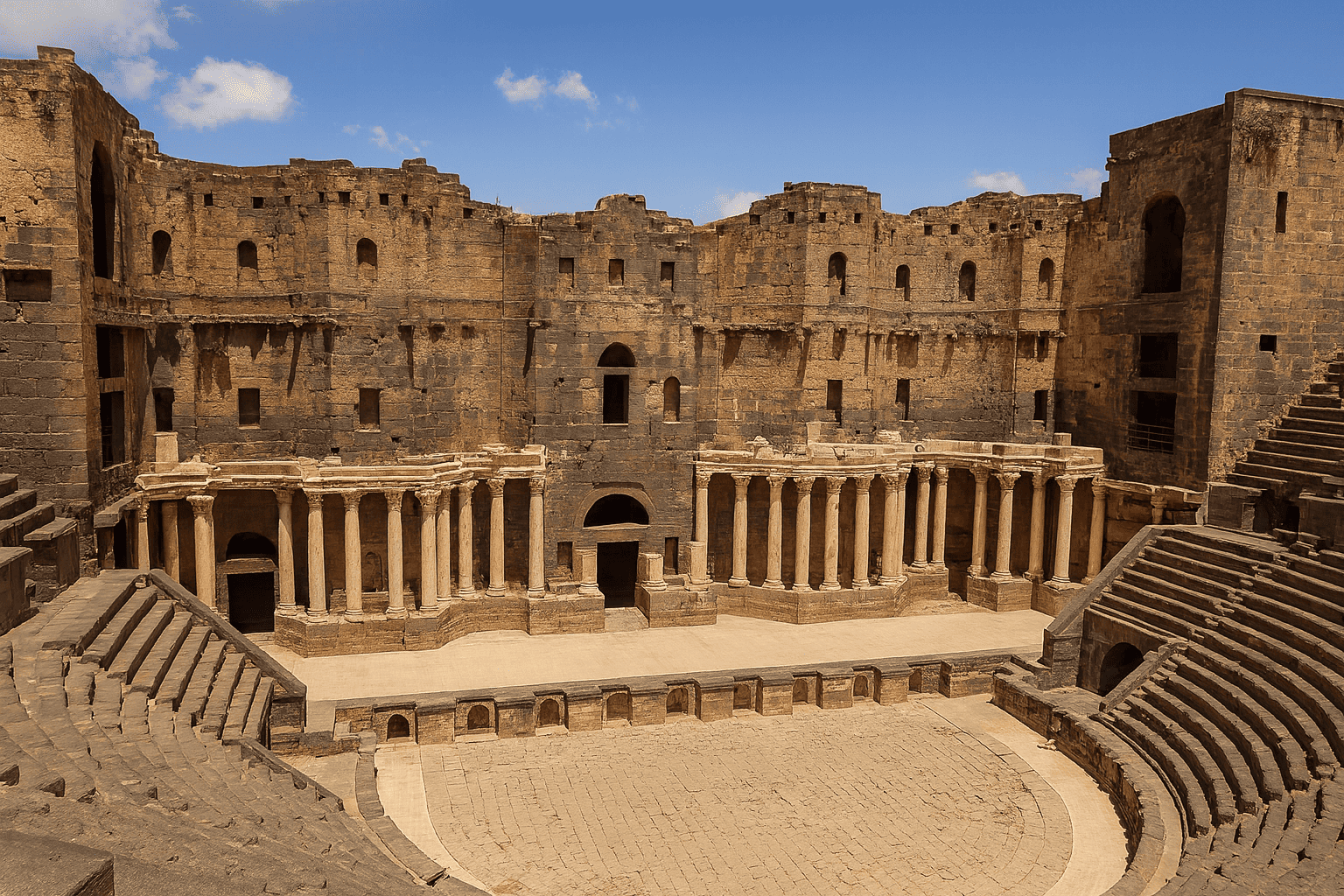
Bosra
In the fertile Hauran plain of southern Syria lies Bosra, a city whose stones preserve the story of empires. First mentioned in Egyptian records of the 14th century BCE, Bosra rose to prominence as the northern capital of the Nabataean kingdom before being annexed by Rome in 106 CE. Under Emperor Trajan, it became Nova Trajana Bostra, the capital of the new province of Arabia Petraea, where legions were stationed and caravans from Arabia and the Red Sea converged. The city flourished with colonnaded streets, baths, and aqueducts, crowned by its magnificent 2nd century Roman theatre — one of the best preserved in the world. In the Byzantine era, Bosra became a Christian center, its bishops attending great councils, and its cathedral standing as one of the earliest domed churches. With the coming of Islam in 634 CE, Bosra was the first Byzantine city to fall, transforming into a key station on the Damascus–Mecca pilgrimage route. The al Omari Mosque, among the oldest in Islamic history, still recalls that era. Later fortified by the Ayyubids and Mamluks, the theatre itself was turned into a citadel, guarding the caravan routes of the Hauran. Though it declined under Ottoman rule, Bosra remained a living village amid its ruins until modern times. Today, as a UNESCO World Heritage Site, Bosra endures as a layered city — Nabataean, Roman, Byzantine, and Islamic — a crossroads where civilizations met, and where the echoes of empire still resound in stone.